Cracked mirror or dead lamp: drive it or park it?
Some are advisories you fix at the depot. Some stop you driving there and then. The difference usually comes down to two questions.
The common ones, and what they are
| Fault | Verdict | Why |
|---|---|---|
| Hairline-cracked mirror that still gives a clear, undistorted view | USUALLY OK | Record it and replace it, but the view is what the law cares about. |
| Required mirror missing, shattered, or so damaged the view is lost | FIX IT FIRST | Fix before a route with cyclists and pedestrians. Graduated fixed penalty, usually band 1 (£50), non-endorsable unless the condition is dangerous. |
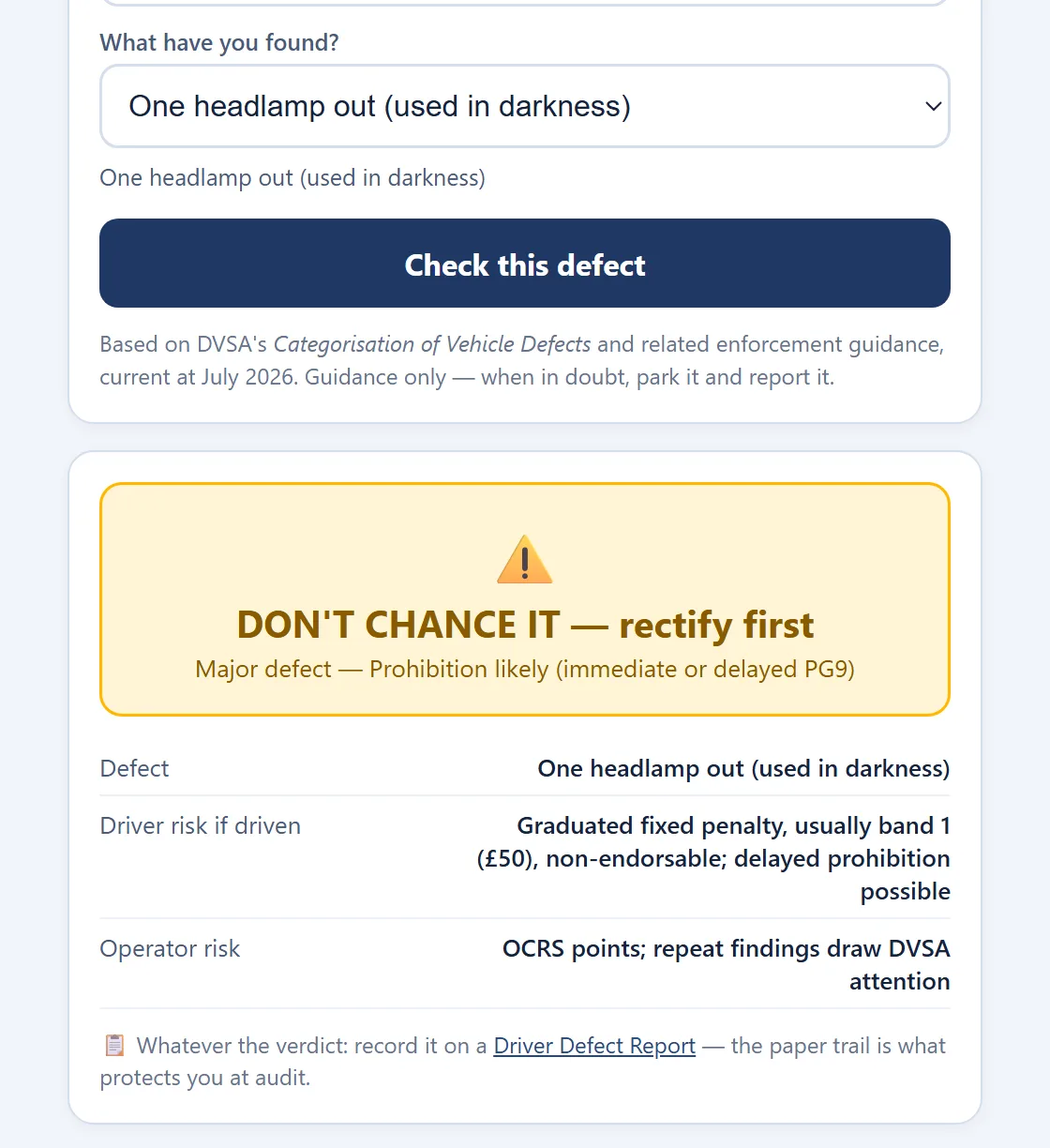
| One headlamp out, and you're driving in the dark | FIX IT FIRST | Graduated fixed penalty, usually band 1 (£50). Lighting offences are non-endorsable, no points, unless the defect is bad enough to be charged as a dangerous condition, which carries 3 points. A delayed prohibition is possible. |
| One brake (stop) lamp of two not working | FIX IT FIRST | Rectify before further use: you're down to one warning to the vehicle behind. |
| Both brake (stop) lamps not working | PARK IT | No braking signal at all: prohibition, and rightly so. |
| Side/marker lamp out in daylight, good visibility | USUALLY ADVISORY | Fix at the depot, but don't let it wait past dusk. |
| ABS / EBS warning lamp stays on | FIX IT FIRST | A braking-system warning: a delayed prohibition is common. |
Why "are you in the dark?" matters so much
A lot of lighting faults change category the moment the light fades. A single dead headlamp in bright daylight is a defect to log and fix; the same lamp at night, in rain, on an unlit road, is a genuine danger and far more likely to earn a prohibition. If a fault affects a light you're actually relying on now, treat it as fix-first, not fix-later.
The honest test for a cracked mirror
The mirror rule is about the view, not the crack. If a chip or hairline crack doesn't distort or obscure what you need to see, you're generally legal: record it and get it replaced. If the mirror is shattered, missing, or the crack breaks up the image so you can't properly see down the side of the vehicle, don't set off, especially where vulnerable road users will be.
Not sure how a fault is categorised?
Pick the vehicle, the area and the defect, and the HGV Defect Checker, 3 free checks, gives you the drive-it / fix-it / park-it call and the likely penalty, straight from DVSA's categorisation.
Try 3 free checks → More guidesBased on DVSA's Categorisation of Vehicle Defects (examiners' handbook) and related enforcement guidance, current at July 2026.
Guidance only, not legal advice. Penalties vary with the circumstances, and at the roadside the call is the examiner's on the day. Roadworthy is an independent tool provider and is not affiliated with, or endorsed by, DVSA.